

Europe urgently needs a better playbook for AI policymaking, one that grapples with how rapidly AI has been unfolding. Today, such a playbook was released: the “Transformative AI Strategy for Europe”, available here. I’m biased, because friends of mine were involved in its making. And I don’t agree with everything in it. But it does, in large part, represent a huge improvement over the policy status quo, both in discussing Europe’s current position and in the policy options it presents.
The central thing the strategy gets right is that it takes seriously the possibility of extremely powerful AI systems arriving soon. Across 206 pages, it lays out an intensely detailed array of policy recommendations that can be put into three buckets: securing access to frontier AI, building economic strength, and ensuring Europe’s resilience against AI risks.
This is much better than what the Commission has preoccupied itself with since passing the AI Act: planning to put €10 billion into AI Gigafactories that may provide 600MW of compute by 20301—little more than OpenAI’s Stargate Abilene has brought online since land clearing in May 2024. Or funding AI development through the “2026 Frontier AI Grand Challenge”, the sole winner of which gets 2.5 percent of Europe’s public supercomputing capacity (EuroHPC)—one thousandth the final capacity of that same Stargate Abilene.2
The TAI strategy is closer to reality.
It recognizes that the best AI systems are developed in the United States, which is unlikely to change. As a consequence, the authors put a lot of weight on how Europe can ensure reliable frontier AI access, discussing a threefold strategy of i) creating a supply-chain alliance among middle powers, ii) making sure European governments want frontier AI, and iii) collaborating with US hyperscalers to build compute, which could be traded for frontier AI access. The strategy further considers a large number of other issues, from labour markets and AI safety to AI assurance technologies.
A lot of this is commendable, and I recommend reading the bits of the strategy most relevant to your work. But the strategy does leave out one issue I think is particularly important.
Let’s say Europe has frontier AI access (we do right now across most domains). What do we do with it? Will our economy grow at rates comparable to those of the United States? Most likely not. The TAI strategy has good recommendations on improving economic policy: larger capital markets, better equity taxation, and insolvency reform. But it doesn’t grapple with Europe’s fundamental economic constraints: a shrinking energy supply, intense levels of regulation, and a business environment for international companies whose unpredictability (sometimes) better befits a middle-income nation.
Many of the report’s economic recommendations further rely on the European Union, which has over the past few years often proven unable to be a champion of economic growth. The AI Act’s high-risk regulations, which—even though they will hamper AI adoption across the Union—have seen little reform. Energy policy is in large part a nation-state concern. Addressing it is fundamental to European success: since the financial crisis, Europe’s electricity supply has been cut by 264 TWh—exactly the amount that would be required to power the 30GW draw of all AI data centers currently active across the globe. Similarly, there is little mention of building more gas power plants or reactivating nuclear power plants, both of which could do much to power Europe’s share of data centers.
Not discussing the above might simply be the price you pay for having to find agreement among the strategy’s senior supporters, who span the political spectrum. And finding such agreement is really commendable, especially because the authors were able to arrive at ambitious policies in many other areas.
But we will, ultimately, need to arrive at a better political consensus on how Europe can overhaul its decade-long policy consensus, so it can finally achieve growth rates that are on par with those of the United States and China, thus allowing us to match their military strength, state capacity, and global purchasing power.
But for now, let’s look at the report’s other recommendations. Many of them do finally resolve some of the many myths and omissions that have been haunting European AI policy, which is a big achievement.

Building Europe’s AI safety infrastructure
The European AI Office is providing an invaluable global public good via its mandate to mitigate catastrophic risks from AI. But Europe at large remains unprepared for AI risks. The TAI strategy provides a corrective to this, laying out how Europe can rapidly set up infrastructure that provides resilience for the years to come.
Just this past week, the Frankfurter Allgemeine Zeitung provided a considered treatment of the question of whether AI might kill us all. Such risks were long a sideshow in Europe, with the AI Act originally focusing on relatively conventional risks. Back in 2024, a small number of smart, mission-driven individuals ensured that the Act also considers the worst risks of AI, be they CBRN, cyber offence, or loss of control. But across Europe, AI companies are often still seen as conventional big tech companies that spread misinformation and show political bias.
The TAI strategy focuses much more on true AI resilience, which prepares us for the largest risks from AI. There is so much we can do here. It starts with simple things: buying enough personal protective equipment so that essential workers can make sure society continues to function, even during a worst-case pandemic. Screening DNA orders, so malicious humans (or AI agents) can’t order smallpox. Or sending cybersecurity experts into public administrations equipped with a cyber-capable frontier AI system to check whether there are vulnerabilities that open-source AI systems might exploit. Once these simple things are done, you can next truly secure the DNA supply chain, or set up an ambitious European surveillance program for detecting engineered pathogens—something I’ve previously written about.
The US government has yet to act on many of these strategies. The world could thus be much safer if we bet on some European nations finally preparing for the risks AI might bring. For example, Switzerland already has 370,000 bunkers and shelters for its entire civilian population. It’d be great if more people lobbied Bern to make sure said infrastructure can withstand particularly bad biological risks!
Equipping European governments with frontier AI
A further thing Europe needs in order to respond to the challenges posed by AI is the use of AI across government. The TAI strategy’s thoughts here are straightforward and correct. We should simply “bring frontier AI expertise and technology into European institutions”.
We have, right now, AI systems that some people call AGI. However you classify a model like OpenAI’s Astra or Anthropic’s Fable, these are extremely powerful systems available on commercial markets. But I expect current uptake across European institutions to be very poor. The report addresses this directly, with a simple recommendation that might be among its best, namely
[measuring] [...] the time lag between public frontier model release and internal roll-out of the model [...]
I was further happy to see the call for amending the Cloud and AI Development Act, a Commission proposal that would add a lot of additional procurement paperwork for governments that want to adopt AI. That alone could be a death knell for adoption, given that even private companies with far more freedom are already relatively slow to adopt AI systems. But the Commission’s provisions for sensitive workloads might make it unworkable to access the world’s best American models in national-security contexts. If a future American administration wants to provide us with a model that is, for all intents and purposes, superintelligent, individual European governments could simply be blocked from accepting the offer because of Brussels law. The strategy’s recommendation would avert this outcome, saying that:
“Models should be chosen on capability regardless of origin, with the proposed CADA Article 32 preferences only being applied in cases where EU models are competitive with the frontier AI models.”
This would mean that in many cases, governments should remain free to use non-European AI models (which really suggests we cut the procurement requirement entirely, putting trust in nation states to decide which balance of US reliance and security they prefer).
The fiscal dangers of racing to the frontier
Using AI in government will be difficult, however, if the US government shuts us out of frontier access. This worry is understandable. The strategy authors address access risks extensively, suggesting a variety of smart strategies on how to make access more likely, both via compute for access deals:
“Europe should therefore use ‘compute for access’ deals to exchange attractive data centre sites for contractually agreed frontier model access, underwritten by contractual guarantees backstopped by physical leverage.”
and by using its AI supply-chain to secure chip access:
“If the US sought to prevent the sale of advanced AI chips to such a project, the coalition could respond by restricting access to relevant inputs – such as EUV lithography machines, critical raw materials and, if East Asian countries participated, memory chips – that US companies need for their own frontier development.”
But there is another method to secure AI access: building our own AI model. The authors write that Europe could go for a Manhattan Project-scale endeavour, but that it would be very risky. In large part, they treat this issue right, but I did have some open questions after reading. But first, their high-level recommendation:
reaching the frontier [...] would require Manhattan Project-scale expenditure and resolve and could not be achieved by private companies without massive state support. If Europe attempted to create a European frontier AI project but failed to mobilise the necessary resources, it would be in a particularly bad position: it would still lack domestic frontier AI, but it would have spent a lot of capital and attention on a failed bet.
The authors put total costs at a whopping €790 billion over three years. This is similar in scale to other plans, such as the French Prometheus Plan. The authors are cognizant of the massive political resolve required:
A successful European frontier AI project requires broad coalition-building, a wide-reaching reordering of European industrial priorities, and committing the majority of Europe’s leverage to securing access to chips and defending against foreign intervention instead of securing other near-term goals.
But I’m somewhat surprised by how blasé the report is about the project’s impact on our fiscal position, saying that “the principal constraint is thus not fiscal capacity, but a sustained political commitment.” I agree that, once commenced, the project would most likely fail due to countries pulling out. But securing €790 billion in public funding right now would be extremely hard. The finances of most large European nations are in poor shape. EU government debt has increased from 59 percent of GDP before the financial crisis to 83 percent today. Germany sits at 64 percent, the UK at 94 percent, and France at 118 percent (while you might think Germany still has fiscal space, its current debt trajectory is already putting the coalition under strain).
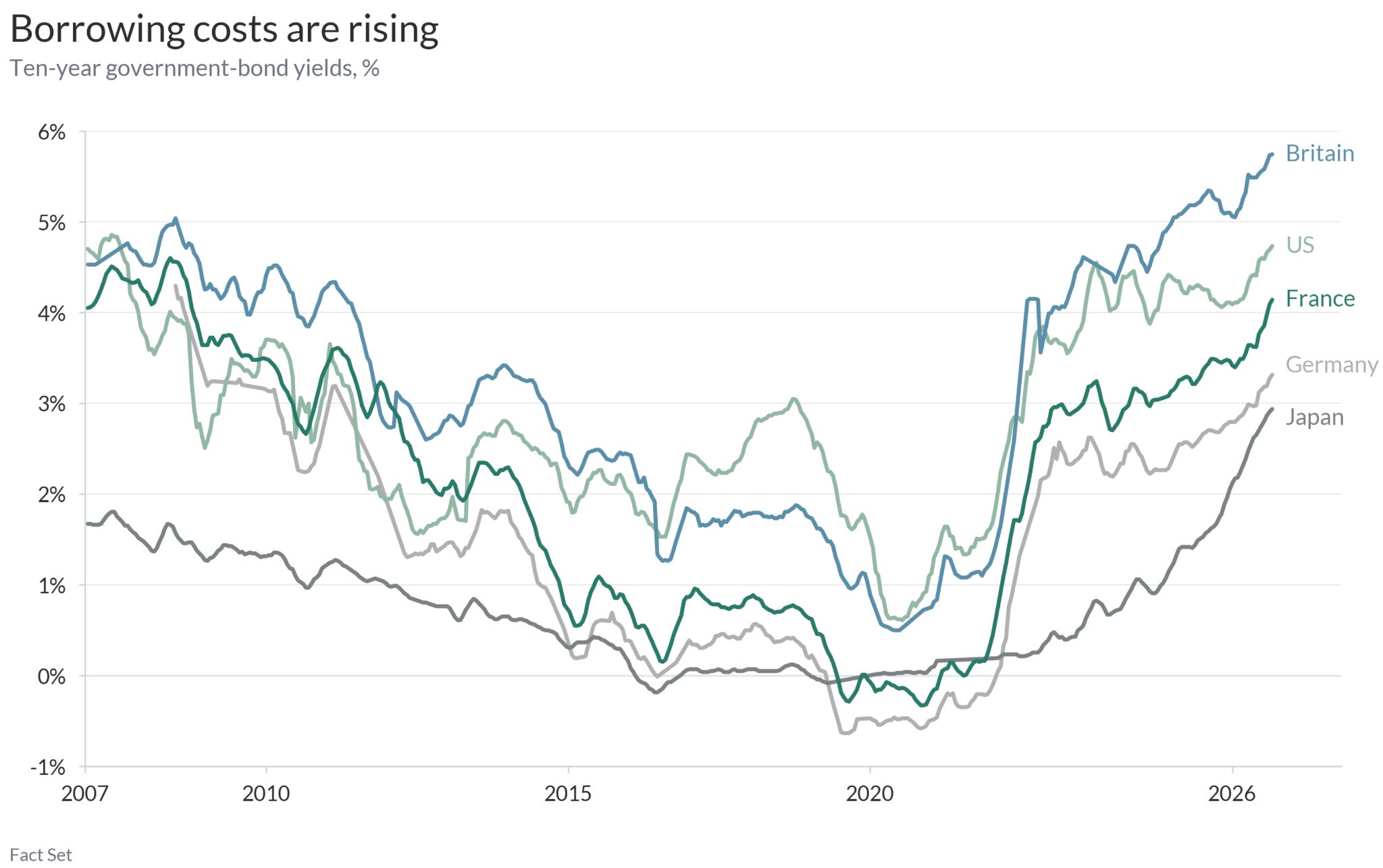
Adding even more debt would be very costly. Ten-year government-bond yields are close to six percent in Britain, over four percent in France, and nearly three percent in Germany. If Europe went for an AI Manhattan project, rates would likely rise even higher, both because governments would need to take on even more debt and because they would have to compete for capital with an ever-expanding privately run AI data-center buildout. Already, the surge in corporate borrowing has pushed long-run US Treasury yields up by 0.2 percentage points.
And I’d expect private markets would be very skeptical that European governments are in a good place to use all this money productively, compared with US hyperscalers, which in 2026 alone have issued around €215 billion in corporate bonds.
What would the project give us? Maybe a relatively competitive AI model after two to three years. But would we make returns on it? I’m very unsure. The models by Meta and Google are decent, but make little money, with close to all AI revenues going to OpenAI and Anthropic instead. The authors address this by saying that the model could
[become] the main provider of frontier AI to coalition governments, supplying private actors with high security requirements, and, where necessary, adopting measures to increase the use of European frontier AI by domestic businesses can help achieve successful commercialisation.
In my mind, this undersells the gargantuan economic intervention of forcing European businesses to use an inferior AI model compared with companies abroad. And in the likely event that the AI model is inferior to other offers, wider procurement mandates will be necessary: large European nations spend around €6 billion on digital services. Even if three nations spend €1.5 billion each on this model, that would add up to €4.5 billion, around seven percent of Anthropic’s revenues, and thus nowhere near enough to sustain further AI development. And procurement mandates would face massive backlash from the wider economy. Google engineers themselves protested when they were forced to use Google’s coding tools instead of Anthropic’s or OpenAI’s models.
It’s good that the authors clarify the large cost and downside of the project. They acknowledge that getting such a project right would be extraordinarily difficult—Google has struggled to match OpenAI and Anthropic, and its corporate structure is much more geared towards success than an alliance of democracies would be.
But I do worry somewhat about the level of detail with which the report describes a possible AI project, spending thirteen pages on how it could be done, including detailed cost breakdowns of the project, advice on how to secure compute, talent, and funding, and recommendations on commercialization. Most likely this is a smart “show-don’t-tell” device, which shows the enormous risk of a European state-run AI effort by laying out in painstaking detail what it would entail. But to me, this is a bit too Straussian for comfort. I think any discussions of building our own model can be risky, because—beyond supply-side measures—many policies in support of a publicly funded model, be it public financing, procurement mandates, or allocating scarce talent to such an effort, would harm Europe to little benefit.
The counterfactual to governments taking on €790 billion in debt looks quite a bit better. If we never borrowed it, interest rates would be lower, our fiscal position would be much improved, and our economy would be less burdened by future taxation. And I see many other more robust cases for government lending, such as funding a vast energy buildout instead.
The report does provide a valuable reality check on what European racing looks like (and why it could be dangerous). I do hope subsequent communications on the report continue to emphasize why racing to the frontier is a risky path (or simply uses their detailed description as a jarring fallback when governments have questions about what it would take to get their own AI model). Maybe they could even include some thoughts on what all this public funding could achieve instead.
Where to go next
Europe grappling with AI more seriously is overdue. I only mentioned some sections of the TAI strategy, and I really recommend that you read it. It provides policy recommendations that are much closer to the scale of the problems Europe is facing than anything we’ve seen before.
I do think we will need additional careful thinking about how Europe can grow its economy and industrial base in a world with transformative AI. And I remain convinced that much of Europe’s success rests in the hands of national governments, which feel economic pressures much more than European Union policymakers.
But for now, I am happy that such a large set of influential Europeans have decided to grapple more seriously with the century’s largest policy challenge.
Disclaimer: I wrote this piece very quickly, and it’s likely I missed important details across the report’s 200+ pages. Feel free to flag if that is so!
The Commission defines an AI Gigafactory as having over 100,000 advanced AI processors. For scale, 100,000 Nvidia H100 SXM GPUs at 700 W each would draw 70 MW; applying a 1.3 facility overhead gives roughly 90 MW per site, or ~0.6 GW across seven Gigafactories.
EuroHPC provides roughly 2 exaflops of sustained compute in aggregate; 2.5% is ~50 petaflops, equivalent to about 1,200 GH200s running continuously for a year. Compare that to the 1,000,000 H100-equivalents in Stargate Abilene.